Pages

Monday, 16 May 2011

A little help from your friends


Much progress over the last week on the blue quilt, which was a bit unplanned, as I'd intended to try to make more or less equal progress on the two quilts. Mostly, this is because I'm lazy and, when I used different colour thread for each of them, I and decided it was easier to stick with one quilt for a bit rather than change the cotton over all the time.

Which has turned out well, as I've discovered that my quarter inch seams are a bit more than a quarter of an inch. I'm stuck with it for the blue quilt, but I can re-do the small amount I've done of the pink one and rectify the situation.

For the blue quilt, I think I'll add a couple of borders to compensate.

From all these strips:

sewn together, cut up and sewn back together in a different order:
Then cut up again, and sewn back together:

Until you start to get something like this:

and this:
I had a little help with the sewing, in the person of the very inquisitive Rosa:


and also while I was laying the squares out on the bed (in lieu of a design wall):

Although to be honest, I don't think Roger was very interested:

Saturday, 9 April 2011

Made to last

Today I bought my first sewing machine. No, that's not right. Today I bought the first sewing machine I ever bought.


My mother taught me to sew when I was a child. I was probably about 10 or 11 - I know I had a reasonable idea what I was doing when I hit needlework class (was that what it was called?) in high school, by which stage I'd have been 12. It's all a bit hazy, because we're talking about more than 30 years ago now.

I learned on my mother's machine - a Singer from the early 1960s.

I know it was older than me, because there's a photo of mum, heavily pregnant with me, using it to hem curtains.

I can't find a photo that looks exactly right but she was a lot like this (although without the table).


This and also this are also both pretty close.

Sometime in my early 20s, Mum got a new machine and gave me the old one. And for the next 20 odd years it worked like a dream. For most of that time, I did quite a lot of sewing, too, so it's not like it was sitting idle.

(It wasn't idle for its first 25 years with mum, either. She made clothes for me and my sister when we were children, as well as for herself, and we both learned to sew on it.)

It finally started to give up the ghost a few years ago, at a time when I wasn't doing much sewing. So that worked out ok, until a few weeks ago when I started thinking I'd like to get back into it.

Isn't that just the thing? You start seeing a crafty project or two that requires a sewing machine, and before you know if you've got a to do list of a couple of dozen ideas.

So I thought I'd bite the bullet and buy a new machine. I'm pleased to discover that it's rather like riding a bicycle -- it all comes back to you quite easily. Or it has so far.

I started with this exceptionally cute little boxy pouch, which is now providing a home for all the spare feet and empty bobbins and other bits and pieces that come with the machine.

Sunday, 3 April 2011

Improvise

I've been on a smallish shawls binge for a while now.


This is Indigenous, and it's intended as a birthday gift for my sister (birthday not until July - I can't believe I'm this organised). The yarn is the merino/tussah silk mix Yet from Miss Babs in Old Gold.


Indigenous is a clever design, starting from just 3 sts. The triangle just grows and grows, so it's one of those designs where you can make it as large as you like. I might make another, larger one, for myself.

And this is Annis. Also planned as a birthday present, this one for my mother (in June). Also in Yet, the colour is called French Marigold.


Another clever design, you work the long, lacy edge first then shape the crescent-like body by working short rows over stocking stitch.

The edge is an Estonian pattern, or Estonian-influenced:

Look, nupps!


Still on the needles, is a (modified) version of the Beginner's Triangle from A Gathering of Lace for myself. The modification is nothing terrifically exciting, just changing the pattern from garter stitch to stocking. But more of that another day.

I've always pinned blocking out inside previously - on the bed, on the floor - so this is my first venture in blocking in the open air. Since you shouldn't block (or dry) your knitting in full sun, I had to improvise a bit this morning blocking Indigenous:

It's a lovely warm Sydney early autumn kind of day, so she dried really quickly and I was able to pin out Annis as well. Pinning out yarn inside, I'm used to waiting all day for it to dry, so this is a real bonus.

Sunday, 1 August 2010

Back lanes and byways

blue sky with a few scant white clouds seen above a row of houses
Today, Sydney turned on one of those beautiful end-of-winter days full of the promise of spring. The kind of day that makes you forget that the weather forecast for the coming week seems to be full of temperature drops and more rain.

Anyway, the sunshine lured me and the camera out of the house and on a wander around the local streets, especially up and down some of the back lanes where, amidst the garage doors and back lane detritus you get little reminders that some of the houses front the lane

ceramic tiles with the house number 2B in blue on a creamy white background and decorated with lemons top and bottom
and occasionally there's a tempting glimpse of what lies beyond,
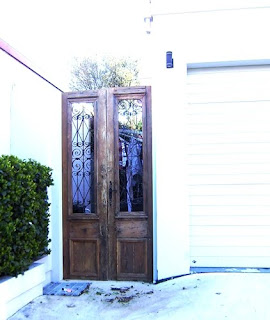
A timber door, weather-stained and with some iron work in place of what might have been the top panel, set into a wall surrounding a house. Its clear that there's a garden beyond, but you can't really see it (without getting closer and peering in, which would be rude!).
forever hidden from you unless you know the magic password to unlock the door (or, you know, have a key).

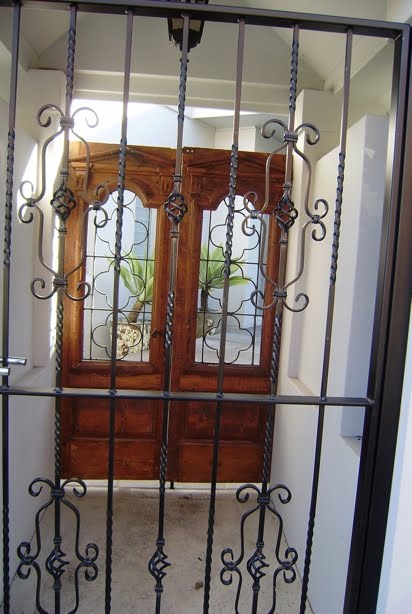
Two doors. The first, more a gate or ironwork. Beyond it, a pair of timber doors, with more iron work in the upper panels, through which is visible some cactus-y plants in pots standing in a paved courtyard. There is a space between the doors, like a portico.Houses in the lanes don't have the kind of showy front gardens you see in the streets, but you'll find something like this bougainvillea stretched out against a wall in the sunshine,

A pink bougainvillea flower on a long stem, silhouetted against a wall.
or a camellia in a pot next to a garage door for no reason other than to be there,
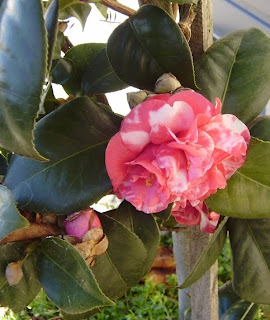
A pink and white camellia flower. Probably a camellia japonica, but I'm no expert. or a hibiscus poking up above someone's back fence.

yellow hibiscus bud
There's a house near here that looks for all the world like it must at one time have been a church of some sort, judging by the shape of the door (mirrored in the iron gate)

A door to a building - well, house these days. The door is timber, made of vertical slats, and shaped like an arch, but with a very pointed top. It is in two halves, and there are matching round iron rings which appear to serve as doorknobs. The brickwork surrounding the door mirrors and emphasises the pointed arch shape, as does the ironwork in the gate, visible in the front of the photo.although the stain glass in the windows looks more like tales from Camelot that the lives of the saints. (I'm trying to work out if I should feel slightly guilty wandering around about photographing people's doors and plants, but I draw the line at windows. You'll just have to take my word for it.)

a cluster of small white flowers just beginning to bloom. Its an Australian native of some sort, I think. My spring is in the air feeling seemed to be confirmed by the local plant-life.

another native shrubby-tree with small flowers just starting to apear.
I'm pretty sure these are all (Australian) natives, although I couldn't put a name to any of them (several grandparents would probably be appalled, were they still alive to know this - I am the generation that gardening skipped).

the new shoots on this shrub are a pinky-red colour, in contrast to the green of the established leaves
I can identify a tibouchina, though. They always makes me smile, possibly because of the cheerful purple flowers, but more likely because I'm reminded of the one we had in the garden when I was a child. I always assumed they were native (to Australia), but apparently they come from Brazil.

large, bright purple tibouchina flowersProving that nature triumphs over adversity, these grasses seem to thrive behind the chicken wire that surrounds what used to be a petrol station but has been a neglected vacant lot for about 10 years now,

Some kind of large grassy plant - probably not a bulrush, but similar.
not to mention the azalea in my front garden that's flowering in spite of my neglect (evident in the rather sad state of the leaves, which I'm sure indicate an absence of something in the soil).

White azalea flowers

Monday, 26 July 2010

Estonia meets the Mohave desert - or the aeolian shawl


A seemingly odd combination, until you read Elizabeth Freeman's lovely description of the desert influences on her pattern. The piece pinned out above shows yucca, the first of the patterns in the shawl.

This was another one of those patterns that I knew I wanted to knit as soon as I saw it, and that was mostly because I wanted the experience of knitting it. I mean I want the finished article as well, but it's becoming increasingly obvious to me how much of a process knitter I am. Point me at something that inspires a "that looks difficult" or "that looks different" or "I haven't seen/done that before" and there's a good chance it will end up on the I-want-to-knit-that list.

I'm opting to knit this without the beading - in large part because I'm not sure I have the patience to place more than 2000 beads.

And here she is on the needles with stitch markers in place to help keep me on track. The pattern really isn't difficult (for anyone with some lace experience) - or hasn't been so far (hope I'm not jinxing myself for later sections!).

My tip, for anyone new to lace and repeating patterns (everyone else probably already knows this), is liberal use of stitch markers, as illustrated below.


A marker between each pattern repeat means that if (when) you do stuff something up it shows up a lot sooner - you tend to discover it in that repeat, rather than getting to the end of the row only to discover you're out by a stitch. I reckon its worth it, even in something like this where there's a bit of moving markers around - in this particular pattern when you get back to the beginning of the 8 row repeat, the next set of 8 rows is offset several stitches relative to the set you just completed.

Wednesday, 21 July 2010

Block party

close up detail of pattern in laminara shawl
I've been on something of a blocking (or rather re-blocking) spree since I got the interlocking tiles. Should have done this years ago.

print o' the wave shawl pinned out on blocking matI've been meaning to re-block both the laminara and the print o' the wave for a while now. I'm not sure if I just didn't block them very well first time around- long enough? wet enough? tight enough? - or if it's something to do with the composition of the yarns.

close up of print o' the wave shawl
The laminara is in JaggerSpun's zephyr wool silk, which is 50/50 merino and tussah silk, and the print o' the wave is in a Fibreworks yarn which is a mix of merino and possum (which they don't seem to make any more).

laminara shawl pinned out on blocking matThis time, I've been pretty aggressive - especially with the laminara; soaked them, and left each of them pinned out overnight to be sure they've dried completely. Will be interested to see if they hold up a bit better over time.

Monday, 19 July 2010

Ends and beginnings

All lace is a little odd and lumpy while you're working it and before it's blocked, but Muir creates these fabulous little mountains.

Pinned out on the new blocking mat, of course, it's a different story. After several years of blocking knitting on the bed, I bought some interlocking foam squares - which are already looking like an excellent investment. No more having to pin the knitting out as early as possible in the morning in the hope it would be dry in time to go to bed that night.

With Muir done and (nearly) dusted, I'm looking at the second of the kaalund yarns - poinsettia - which is going to be Elizabeth Freeman's aoelian shawl from Knitty. At the moment, the pattern - or the first of the several patterns - is resisting my attempts to get into its rhythm, but it'll come.